Scroll vs Reciprocating Compressors: Performance Comparison and Application Guide
Compare scroll vs reciprocating compressors across efficiency, reliability, noise, cost, and applications to choose the right refrigeration compressor.
Choosing between a scroll and a reciprocating compressor is one of the most practical decisions in refrigeration and air-conditioning system design, replacement, and spare-parts planning. Both compressor types are widely used, but they behave differently in the field. Their efficiency profile, serviceability, noise level, tolerance to operating conditions, and replacement cost can all affect system performance and long-term operating expense.
For distributors, service companies, and refrigeration contractors, the key question is not which compressor is universally better. The real question is which compressor type is better for a specific application, load profile, service environment, and customer budget.
What is the difference between scroll and reciprocating compressors?
A reciprocating compressor uses pistons moving inside cylinders to compress refrigerant vapor. It is a well-established design used across air-conditioning, refrigeration, and cold-room systems. Because of its long history and broad installed base, many technicians are familiar with its operation, troubleshooting, and replacement procedures.
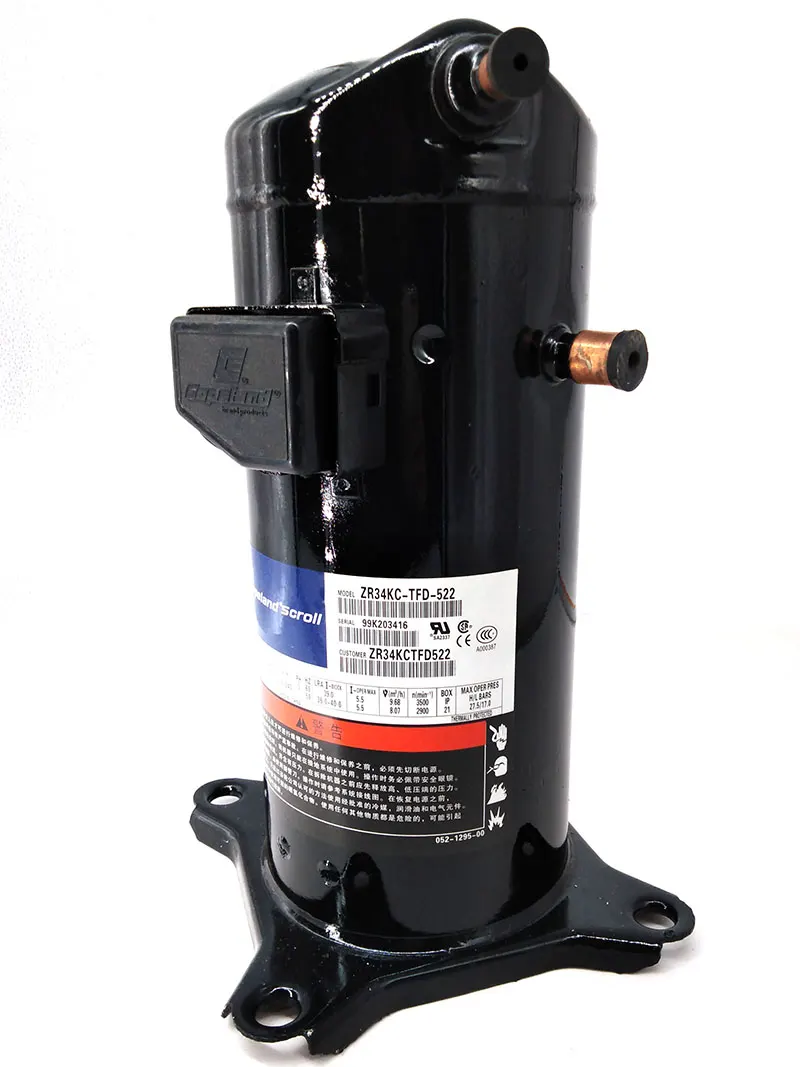
A scroll compressor uses two spiral-shaped scroll elements. One remains fixed while the other orbits, progressively compressing refrigerant gas toward the center. This design has fewer major moving parts in the compression process than a reciprocating unit and is often chosen where smoother operation and strong part-load behavior are important.
In practical terms, the core differences usually show up in these areas:
- Compression mechanism and moving-part count
- Noise and vibration characteristics
- Efficiency under different load conditions
- Sensitivity to liquid return and contamination
- Ease of field repair versus full replacement
- Typical purchase price and lifecycle cost
Performance comparison: efficiency, noise, reliability, and operating behavior
Efficiency
When buyers compare compressor types, efficiency is usually one of the first concerns. In many comfort cooling and medium-duty refrigeration applications, scroll compressors are often favored for their smooth compression process and good operating efficiency. Their design reduces some of the losses associated with suction and discharge valve action found in reciprocating compressors.
Reciprocating compressors can still perform very well, especially in applications that suit their design envelope. In some systems, they remain a practical and economical option, particularly where initial cost matters more than incremental energy savings.
What matters in the field is not only rated efficiency, but how the system actually runs:
- Stable load profiles: scroll compressors often perform attractively where operating conditions remain relatively consistent.
- Variable operating conditions: compressor selection must account for condensing temperature, evaporating temperature, refrigerant, and control strategy.
- Part-load operation: many scroll-based systems are selected for smooth operation during partial load periods.
- System matching: an efficiently designed system with the right compressor can outperform a poorly matched system regardless of compressor type.
For replacement buyers, the best approach is to compare the compressor type in the context of the system, not as an isolated component.
Noise and vibration
Noise can be a deciding factor in commercial buildings, hospitality sites, residential air-conditioning, and equipment installed near occupied spaces. Scroll compressors are widely recognized for quieter and smoother operation. Their compression cycle is more continuous, which tends to reduce pulsation and vibration.
Reciprocating compressors generally create more vibration because of the piston motion and valve activity. That does not make them unsuitable, but it can influence mounting requirements, piping design, and customer expectations in noise-sensitive installations.
This matters to contractors and service teams because excess vibration can contribute to:
- Pipe stress
- Loosened fittings
- Noise complaints
- Increased wear in supporting components
Where acoustic comfort is important, scroll compressors are often preferred.
Reliability and durability
Reliability is never just about the compressor design. It also depends on oil management, refrigerant cleanliness, correct superheat, system charging, and protection controls. Still, there are practical differences between the two types.
Scroll compressors are often valued for having a relatively simple compression mechanism with fewer wear points in the compression chamber. In many well-controlled systems, they deliver dependable operation over long service intervals.
Reciprocating compressors are robust and proven across a wide range of applications. They remain common because the technology is familiar, service knowledge is widely available, and many models perform reliably when properly applied.
However, each type has field sensitivities:
Scroll compressor watchpoints
- Can be vulnerable to damage from severe liquid floodback or slugging
- Require clean systems and correct oil return conditions
- Need proper electrical and control protection
Reciprocating compressor watchpoints
- More moving mechanical parts can mean more wear points over time
- Valve, piston, and bearing-related issues may appear in older or heavily stressed systems
- Vibration management is more important during installation
For service companies, the lesson is simple: application quality often determines reliability more than theory alone.
Cost: purchase price vs lifecycle value
Initial compressor cost and long-term operating cost do not always point to the same choice.
Reciprocating compressors are often selected when budget sensitivity is high. In many replacement and service markets, they remain attractive because of their broad availability and familiar service profile.
Scroll compressors may carry a higher upfront price in some product ranges, but buyers often consider the tradeoff worthwhile when lower noise, smoother operation, and strong efficiency are priorities.
A practical cost comparison should include:
- Compressor purchase price
- Installation labor and retrofit complexity
- Expected energy consumption
- Downtime risk
- Availability of replacement units and spare parts
- Whether field repair is realistic or whether full replacement is more common
For distributors, this is especially important. Some customers buy on unit price alone, while others care more about warranty risk, service call frequency, and lifecycle cost.
Application guide: where each compressor type fits best
There is no single winner across all refrigeration and air-conditioning duties. The better choice depends on application demands.
Where scroll compressors are often a strong fit
Scroll compressors are commonly chosen for:
- Air-conditioning systems where quiet operation matters
- Commercial comfort cooling with steady operating patterns
- Medium-temperature refrigeration applications
- Systems where compact design and smooth running are valued
- Installations where reduced vibration helps piping reliability
In these settings, scroll compressors are often appreciated for their balance of efficiency, sound performance, and operational smoothness.
Where reciprocating compressors are often a practical fit
Reciprocating compressors remain highly relevant for:
- Replacement markets with established reciprocating platforms
- Service environments where technicians want a familiar design
- Applications where lower initial cost is a major factor
- Refrigeration duties where the existing system was designed around reciprocating performance characteristics
- Markets where broad model interchangeability and availability matter
In cold-room service and commercial refrigeration, reciprocating compressors still have a strong position, especially when customers prioritize practicality, stock availability, and straightforward replacement planning.
For cold rooms, condensing units, and packaged systems
For cold-room contractors and refrigeration engineering installers, the compressor decision should be tied to the full operating envelope.
Key checks include:
- Evaporating and condensing temperature range
- Refrigerant compatibility
- Electrical supply and starting conditions
- Load variation across seasons
- Defrost method and return gas behavior
- Space, ventilation, and noise constraints
- Local service capability and spare-parts access
A technically sound match will usually outperform a brand-led or price-only decision.
What buyers, distributors, and service teams should pay attention to
1. Replacement is not just about horsepower or nominal capacity
A compressor replacement should never be selected only by nameplate capacity. Buyers need to confirm refrigerant, application temperature range, electrical characteristics, mounting configuration, oil type, connection size, and operating envelope. Scroll and reciprocating compressors are not always interchangeable without system review.
2. The system history matters
If a compressor failed, the replacement decision should include root-cause analysis. Replacing a failed reciprocating compressor with another reciprocating model, or changing to a scroll, will not solve problems caused by:
- Contamination
- Acid in the system
- Poor oil return
- Incorrect expansion device settings
- Airflow or condenser issues
- Repeated liquid floodback
- Unstable power supply
For service and repair companies, preventing the second failure is often more important than debating compressor type in the abstract.
3. Stock planning should match local demand
Distributors serving export markets and overseas refrigeration contractors often carry both types because customer needs differ by installed base. In some markets, reciprocating compressors dominate the replacement segment. In others, scroll compressors are more common in newer air-conditioning and commercial systems.
A balanced inventory strategy usually considers:
- Installed equipment base in the destination market
- Typical refrigerants in use
- Voltage and frequency requirements
- Fast-moving replacement models
- Seasonal service demand
- Availability of matching electrical and mounting accessories
4. Serviceability affects downtime
Some buyers prefer reciprocating compressors because the design is familiar and, in certain cases, perceived as easier to diagnose in the field. Scroll compressors, meanwhile, are often chosen for reliability and operating smoothness, but many replacement situations still result in complete compressor change-out rather than extensive compressor-level repair.
For end users, the practical question is often this: how quickly can the site be returned to service?
5. Noise complaints can become a commercial issue
In supermarkets, restaurants, hotels, office buildings, and residential-adjacent projects, compressor noise is not a minor detail. It can affect customer satisfaction, contractor call-backs, and equipment acceptance. If sound sensitivity is part of the job, scroll compressors often deserve serious consideration.
Which compressor type is best?
The best compressor type depends on the application priority.
Choose a scroll compressor when the project favors:
- Lower noise and vibration
- Smooth operation
- Good efficiency in suitable systems
- Modern comfort cooling or medium-duty refrigeration applications
Choose a reciprocating compressor when the project favors:
- Lower upfront cost
- Familiar field service practices
- Broad replacement-market demand
- Compatibility with existing reciprocating-based system design
For many buyers, the smartest decision is not scroll versus reciprocating in general. It is scroll versus reciprocating for a specific refrigerant, temperature range, load pattern, site condition, and service model.
Final buying takeaway
Scroll and reciprocating compressors both have an important place in refrigeration and air-conditioning markets. Scroll designs are often selected for quiet, efficient, and smooth operation. Reciprocating designs remain a dependable and commercially practical choice in many replacement and refrigeration applications.
If you are selecting stock for distribution, planning a cold-room project, or replacing a failed compressor, focus on application fit, not just compressor category. Check the operating conditions, confirm compatibility, review the failure history, and match the compressor to the job the system actually has to do.
That approach leads to fewer callbacks, better performance, and more confident purchasing decisions across service, repair, and installation work.
FAQ
What is the main difference between a scroll and a reciprocating compressor?
A scroll compressor uses two spiral elements to compress refrigerant smoothly, while a reciprocating compressor uses pistons moving inside cylinders. This leads to differences in noise, vibration, efficiency profile, and service behavior.
Which is better for quiet operation: scroll or reciprocating compressor?
Scroll compressors are generally preferred for quieter and smoother operation. They usually produce less vibration and pulsation, which makes them a common choice for noise-sensitive air-conditioning and commercial installations.
Are scroll compressors more efficient than reciprocating compressors?
In many applications, scroll compressors are chosen for strong operating efficiency, especially where loads are stable and system design is well matched. However, actual efficiency depends on the full system, refrigerant, operating temperatures, and control strategy.
When should a buyer choose a reciprocating compressor?
A reciprocating compressor is often a good choice when upfront cost matters, the existing system was designed for reciprocating performance, or the local service market prefers a familiar and widely stocked compressor type.
Can a reciprocating compressor be replaced with a scroll compressor?
Not always. A change in compressor type requires careful review of refrigerant compatibility, electrical data, application range, piping, oil requirements, controls, and overall system design. A direct swap without evaluation can create performance or reliability problems.
Buyer Next Step
Move from research to sourcing with a category shortlist, relevant product examples, and a quote request channel.