Can a 50Hz Compressor Be Used on a 60Hz Power Supply? What Overseas Buyers Must Check
A practical guide to 50Hz vs 60Hz compressor compatibility, covering voltage, motor speed, capacity, current, overheating risk, and nameplate checks.
For overseas buyers, compressor replacement is rarely just a matter of matching horsepower or displacement. The local power supply matters just as much. A compressor designed for one electrical system may not operate correctly on another, even if the voltage looks close enough on paper.
The question often appears in export refrigeration projects: can a 50Hz compressor be used on a 60Hz power supply? In some cases, yes, but only when the voltage, motor design, application range, and manufacturer approval support it. In other cases, the result can be higher current, reduced reliability, incorrect cooling performance, or motor overheating.
This guide explains the practical difference between a 50Hz vs 60Hz compressor for refrigeration distributors, service companies, cold-room contractors, and replacement buyers. It also shows what to check before purchasing compressors for international markets.
Why Frequency Matters in Refrigeration Compressors
Electrical frequency, measured in hertz (Hz), indicates how many cycles per second the alternating current completes. Many countries use 50Hz power, while others use 60Hz power. Refrigeration compressors are built around the electrical characteristics of their target market, including frequency, voltage, starting method, protection components, and cooling application.
For an induction motor compressor, frequency directly affects motor speed. A motor connected to 60Hz power generally runs faster than the same motor connected to 50Hz power, assuming the motor design allows operation at both frequencies. This speed change influences refrigerant mass flow, cooling capacity, power consumption, sound level, vibration, and operating temperature.
That is why the label “220V 50Hz compressor” or “115V 60Hz compressor” is not a small detail. It is a key compatibility specification.
50Hz vs 60Hz compressor operation in simple terms
When compressor frequency changes, several operating conditions can change at the same time:
- Motor speed: A 60Hz supply can increase the motor’s running speed compared with 50Hz operation.
- Cooling capacity: Higher speed can increase refrigerant circulation and capacity, but not always within a safe or approved range.
- Power input: Faster operation may require more power and may increase electrical load.
- Current and temperature: Incorrect voltage-to-frequency matching can increase current draw and motor heating.
- Mechanical stress: Higher speed may affect noise, vibration, oil return, and wear.
- System balance: Expansion devices, condensers, evaporators, and refrigerant charge may not be sized for the changed capacity.
A compressor is part of a system. Even if the motor starts and runs, the refrigeration system may not perform as intended.
Can a 50Hz Compressor Run on 60Hz Power?
A 50Hz compressor should not be assumed safe on a 60Hz supply unless the nameplate or technical documentation confirms 60Hz operation. Some compressors are built and approved for both 50Hz and 60Hz, while others are single-frequency designs.
The safest answer is: use a 50Hz compressor on 60Hz only when the compressor is rated for 60Hz at the available voltage and application conditions.
The voltage-to-frequency relationship is critical
Frequency cannot be checked alone. Voltage must be checked with it.
A compressor motor is designed for a certain voltage and frequency combination, such as:
- 220-240V / 50Hz
- 220-230V / 60Hz
- 115V / 60Hz
- 380-420V / 50Hz
- 440-480V / 60Hz
- 220-240V / 50Hz and 220-230V / 60Hz dual rating
A 220V 50Hz compressor may not be suitable for a 220V 60Hz supply unless the motor is rated for that combination. Likewise, a 115V 60Hz compressor is not suitable for a 220V 50Hz system simply because the compressor capacity appears similar.
The key concept is the voltage-to-frequency ratio. If voltage and frequency are not matched properly, the motor’s magnetic conditions can change. This may affect torque, current, and heat generation. A motor may run too hot, fail to start under load, trip protection devices, or suffer shortened insulation life.
Cooling capacity may change on 60Hz
When a compressor designed for 50Hz is operated at 60Hz under an approved dual-frequency rating, it often runs at a higher speed. Higher speed can increase refrigerant displacement per unit of time. In practical terms, the compressor may deliver more cooling capacity at 60Hz than at 50Hz, depending on the compressor design and operating conditions.
This is not automatically a benefit. A higher-capacity compressor in the same refrigeration circuit can cause system-side problems, such as:
- Short cycling if the load is too low
- Different suction and discharge pressures
- Higher condenser heat rejection demand
- Incorrect expansion valve performance
- Changed evaporator superheat behavior
- Increased noise or vibration
- Potential oil return concerns in some systems
For cold rooms, display cabinets, ice machines, and commercial refrigeration units, the system design must match the compressor’s actual operating capacity at the target frequency.
Overheating risk depends on more than frequency
A common misunderstanding is that higher frequency always reduces overheating risk. In reality, compressor heating depends on the combined effect of voltage, frequency, load, refrigerant conditions, ambient temperature, motor design, and starting components.
Possible overheating causes include:
- Incorrect voltage for the compressor rating
- Compressor operated outside its approved frequency range
- High condensing temperature
- Low supply voltage causing higher current
- Incorrect starting relay, capacitor, or protector
- Poor ventilation around the condensing unit
- System restrictions or overcharge
- Application mismatch, such as using a high-temperature compressor in a low-temperature system
For replacement buyers, this means frequency compatibility must be checked together with refrigeration application: LBP, MBP, HBP, air-conditioning duty, refrigerant type, and evaporating/condensing temperature range.
How to Read the Compressor Nameplate Before Export Purchase
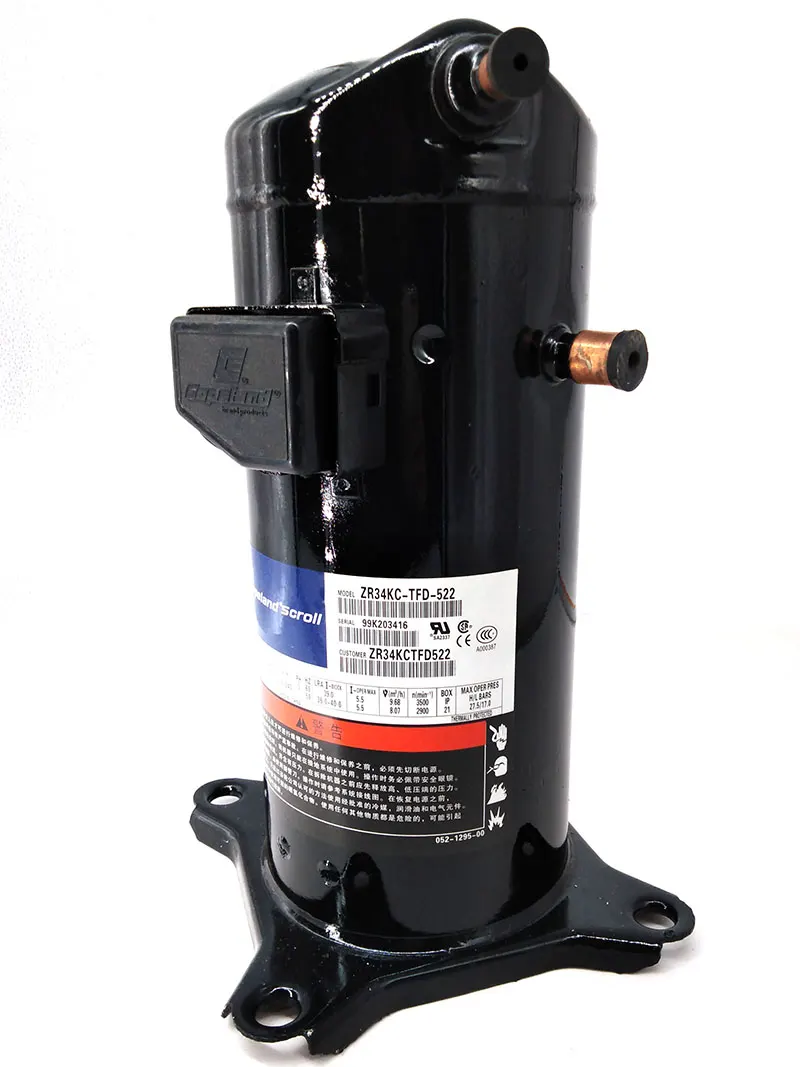
The compressor nameplate is the first place to confirm whether a model can be used in the destination market. For distributors and repair companies importing mixed compressor brands, nameplate reading is essential because two models with similar capacity can have very different electrical ratings.
Key nameplate items to check
Before purchasing or installing a compressor, check these items carefully:
- Rated voltage: The required supply voltage or voltage range.
- Frequency: 50Hz, 60Hz, or both.
- Phase: Single-phase or three-phase.
- Refrigerant: Such as R134a, R404A, R407C, R410A, R290, R32, or others, depending on the model.
- Application range: Low, medium, or high temperature, or air-conditioning application.
- Rated current or running current: Useful for cable, breaker, and overload selection.
- Locked rotor current: Important for starting and electrical protection.
- Starting components: Relay, capacitor, PTC, contactor, inverter, or other approved components.
- Oil type and charge: Important for service compatibility.
- Approval marks: Relevant for the destination market when required.
If the nameplate lists only 50Hz, do not treat it as a dual-frequency compressor. If it lists 50/60Hz with voltage ranges for both, check that the destination voltage matches the 60Hz rating.
Examples of correct and risky interpretations
A compressor marked 220-240V 50Hz / 220-230V 60Hz can generally be considered a dual-frequency model within those stated ranges, subject to the manufacturer’s application limits.
A compressor marked 220-240V 50Hz only should not be used on 60Hz power without written confirmation from the manufacturer or authorized technical data.
A compressor marked 115V 60Hz is intended for a 115V 60Hz supply. It is not interchangeable with a 220V 50Hz compressor unless the entire system design and electrical supply are changed accordingly.
A three-phase compressor marked 380-420V 50Hz should not be assumed compatible with 460V 60Hz unless the nameplate or data sheet lists that rating. Three-phase industrial and commercial systems often have different voltage standards by region.
Do not rely only on horsepower
Horsepower is a rough commercial reference, not a complete selection standard. Two compressors described as the same horsepower may differ in displacement, refrigerant, application envelope, oil, motor winding, voltage, and frequency. Export refrigeration compressor selection should be based on model data, not only on nominal horsepower.
For replacement projects, it is better to match:
- Original compressor model or approved equivalent
- Refrigerant and oil compatibility
- Cooling capacity at target conditions
- Voltage, frequency, and phase
- Application temperature range
- Mounting and pipe connection requirements
- Starting and protection components
What Overseas Buyers Should Check Before Ordering
Frequency compatibility is both a technical issue and a purchasing risk. A wrong batch of compressors can create warranty disputes, installation delays, and customer complaints. Distributors and contractors can reduce risk by building a clear compressor voltage guide into their purchasing process.
Confirm the destination power supply
Before selecting a compressor, confirm the actual site power supply, not just the country name. Some markets have mixed voltage systems, and industrial customers may have different supply conditions from residential or light commercial users.
Confirm:
- Voltage at the installation site
- Frequency, 50Hz or 60Hz
- Single-phase or three-phase supply
- Voltage tolerance and stability
- Available starting current capacity
- Local plug, wiring, breaker, and protection requirements
For replacement compressors, service technicians should measure the supply voltage under load when possible. Low voltage during starting can cause repeated trips or compressor damage.
Match compressor frequency with the refrigeration application
The compressor must be correct not only electrically but also thermally. A model suitable for a medium-temperature display cabinet may not be suitable for a low-temperature freezer room. A compressor for air-conditioning operation may not have the correct envelope for commercial refrigeration.
For cold-room contractors and engineering installers, check:
- Required room temperature
- Evaporating temperature
- Condensing temperature
- Ambient temperature around the condensing unit
- Refrigerant type
- Expansion device type
- Required capacity at the operating condition
- Duty cycle and expected running hours
If a 50Hz vs 60Hz compressor rating gives different capacity values, use the capacity for the destination frequency.
Check starting components and overload protection
Single-phase compressors often depend on specific starting relays, capacitors, PTC devices, and overload protectors. These parts are not universal. A compressor approved for 50Hz and 60Hz may still require the correct component set for each electrical rating.
Using the wrong capacitor or relay can cause:
- Hard starting
- High current draw
- Nuisance overload trips
- Compressor humming without starting
- Motor winding damage
For service companies, replacing the compressor but reusing old starting components can be risky unless the parts match the new compressor’s specification.
Consider the complete condensing unit
When compressors are supplied as part of a condensing unit, the condenser fan motor, contactor coil, pressure controls, transformer, crankcase heater, and other electrical parts must also match the local power supply. A dual-frequency compressor does not automatically make the whole unit dual-frequency.
For export projects, buyers should verify the electrical rating of the full assembly, not only the compressor model.
When to Choose a Dual-Frequency Compressor
A dual frequency compressor is designed and rated for operation on both 50Hz and 60Hz supplies, usually within specified voltage ranges. For distributors selling into multiple countries, dual-frequency models can simplify inventory and reduce selection errors.
Situations where dual-frequency models are useful
Dual-frequency compressors can be a practical choice when:
- A distributor supplies both 50Hz and 60Hz markets.
- The final destination is not confirmed at the time of purchase.
- A service company wants to reduce spare parts complexity.
- An OEM or contractor builds equipment for export.
- Replacement demand varies across voltage standards.
The main advantage is flexibility. However, buyers still need to check the exact voltage rating, refrigerant, capacity, and application range.
Dual-frequency does not mean universal
A compressor marked 50/60Hz is not automatically compatible with every voltage or every refrigeration system. It may be rated for one voltage range at 50Hz and a different range at 60Hz. It may also have different capacity, current, and performance data at each frequency.
Before selecting a dual-frequency model, ask for or review:
- Electrical rating at 50Hz and 60Hz
- Cooling capacity at both frequencies
- Input power and current values
- Approved refrigerant and oil
- Application envelope
- Required starting components
- Mounting and connection details
For overseas buyers, this is especially important when comparing domestic and international compressor brands. Similar model descriptions may hide important differences in electrical rating.
Practical Buying Checklist for 50Hz vs 60Hz Compressor Selection
A clear checklist helps avoid costly mistakes in export refrigeration compressor purchasing. Before confirming an order, buyers should answer these questions:
- What is the destination voltage and frequency?
- Is the compressor nameplate rated for that exact voltage and frequency?
- Is the compressor single-phase or three-phase, and does it match the site supply?
- Is the refrigerant the same as the system requirement?
- Is the compressor suitable for the application temperature range?
- Has the cooling capacity been checked at the destination frequency?
- Are the starting and protection components correct?
- Can the condenser, evaporator, and expansion device handle any capacity change?
- Are pipe connections, mounting dimensions, and oil type compatible?
- Is the full condensing unit electrically compatible, not only the compressor?
The most important rule is simple: do not replace or import a compressor based only on capacity, horsepower, or physical size. Electrical compatibility must be confirmed by the nameplate and technical data.
For distributors, this reduces return risk. For repair companies, it prevents repeat failures. For cold-room installers, it protects project schedules and system performance. For end users, it improves reliability and lowers the chance of unexpected downtime.
A 50Hz compressor can be used on a 60Hz power supply only when the model is designed, rated, and applied for that condition. When the nameplate does not clearly support 60Hz operation, choose the correct 60Hz model or a properly specified dual-frequency compressor.
FAQ
Can a 50Hz compressor be used on a 60Hz power supply?
Only if the compressor nameplate or technical data confirms that it is rated for 60Hz operation at the available voltage. If the compressor is marked 50Hz only, it should not be used on a 60Hz supply without manufacturer approval.
What happens when a 50Hz compressor runs at 60Hz?
If approved for dual-frequency operation, the compressor may run faster and may deliver different cooling capacity, current, and power input. If not approved, it may overheat, draw abnormal current, suffer mechanical stress, or fail prematurely.
Is a 220V 50Hz compressor the same as a 220V 60Hz compressor?
Not necessarily. The voltage looks similar, but the motor winding and approved operating conditions may be different. Always check whether the nameplate lists the correct 60Hz voltage rating.
Why does compressor capacity change between 50Hz and 60Hz?
Frequency affects motor speed. At 60Hz, a compatible compressor generally runs faster than at 50Hz, which can change refrigerant flow and cooling capacity. The system must be able to handle the changed performance.
When should buyers choose a dual-frequency compressor?
A dual-frequency compressor is useful for distributors, repair companies, and exporters serving both 50Hz and 60Hz markets. Buyers must still confirm voltage range, refrigerant, application temperature, capacity, and starting components.
Buyer Next Step
Move from research to sourcing with a category shortlist, relevant product examples, and a quote request channel.